Bruton's tyrosine kinase (Btk) is a cytoplasmic enzyme encoded by the human BTK gene that plays a crucial role in B cell development, survival, proliferation and differentiation. Btk defect leads to X-linked agammaglobulinemia (XLA), a rare genetic disorder that strongly reduces the immune system, thereby affecting the ability of the organism to fight effectively against infections. Btk is also an important target for the development of innovative therapies (i.e., Btk inhibitors) for patients suffering hematologic malignancies such as chronic lymphocytic leukemia (CLL), and mantle cell lymphoma (MCL).
Applications
As rats more accurately reflect human physiology than mice, genOway has developed the first preclinical Btk Knockout rat model (Btk KO) to help scientists study a broad spectrum of medical fields, including:
- Immunology
- B cell malignancies (e.g., diffuse large B-cell lymphoma, chronic lymphocytic leukemia)
- Autoimmune diseases with aberrant B cell responses (e.g., rheumatoid arthritis, systemic lupus erythematosus)
- Hematology (e.g., hemostasis, thrombosis)
- Toxicology
- Screening of novel Btk inhibitors for treatment of several hematologic cancers and autoimmune diseases
- Oncology (e.g., pancreatic cancer, breast cancer)
Model features
- Lack of Btk protein expression
- B-cell developmental defects (i.e., decreased number of peripheral B cells, defects in B-cell maturation and activation)
- Sprague Dawley outbred genetic background
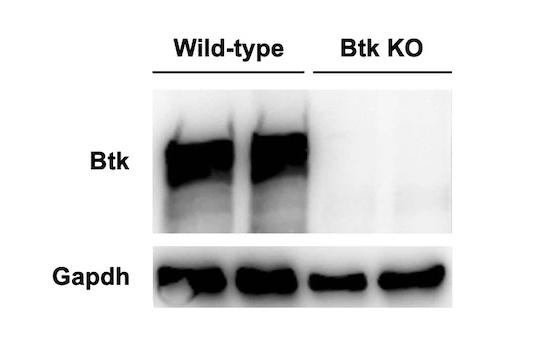
- Homozygous Btk KO rats do not express Btk protein
Western blot analyses of splenocyte samples from wild-type and homozygous Btk Knockout rats (Btk KO). Membranes were incubated with antibodies against Btk or GAPDH as a loading control.
- The number of splenocytes, peripheral B cells and mature B cell population is significantly reduced in homozygous Btk KO rats.
Hemocytometer and flow cytometry counts of splenocytes and B cells in homozygous Btk KO (Btk KO) and wild-type rats. As expected, Btk KO rats display a significantly reduced number of A) splenocytes and B) peripheral B cells compared to wild-type rats, confirming that their spleen is decreased in size. C, D) Flow cytometry analyses of peripheral B cells show that the mature B cell population (CD45RA+) is significantly reduced in Btk KO rats.